On Father's Day this year, the high-voltage battery in my 2022 Tesla Model Y failed. One of the cell groups in the pack developed an internal short, and the car's battery management system quietly decided the whole pack had to go.
I own an EV and hybrid repair shop, so I see failures like this every week. Having one happen in my own driveway, on a holiday, was almost funny. But this post isn't really about the Tesla. It's about what happened two months later, when everything I photographed that day turned into a finished, designed training presentation in about ten minutes. If you've ever wondered what "using AI well" actually looks like in ordinary life, this is the most honest example I've got.
First, the day itself
The first warning was polite: "Maximum battery charge level reduced. OK to drive — Schedule service." Behind that calm little banner, the car had already condemned its own battery. I didn't know that yet. So I did what thirty years of turning wrenches has drilled into me: before touching anything, document what you see.
I photographed the fault-detail screen, the one with the two alert codes on it, and texted that one photo to my friend Matt, who has access to Tesla Toolbox, Tesla's factory diagnostic platform. A few minutes later an "Owner Authorization" email from Tesla showed up on my phone. I approved it, and Matt was reading my car's live data from his phone. The verdict came back fast: a weak short in one cell group, and the battery management system's own internal call to replace the pack. The car confirmed it on its own screen in Service Mode half an hour after the first warning: "Brick weak short — HV Battery replacement recommended."
The car never left the driveway, and I already had the answer.
Which set up something I couldn't resist. If I already knew the diagnosis, then everything the car told me for the rest of the day could be graded against the truth. So I drove it. As an experiment. Phone in hand.
The car failed the exam spectacularly. At a Supercharger in Hood River, sitting at 38%, it announced it was "Preconditioning battery for fast charging" — for a charge it could not accept. Minutes later: "Charging Complete. +0 kWh." Still at 40%. The service request in the Tesla app had no path for a dead battery, so I filed my most expensive component's failure under "Something Else" and typed it out in free text. And directly under the "Unable to charge" banner, the screen offered me Sketchpad: "Draw while you wait."
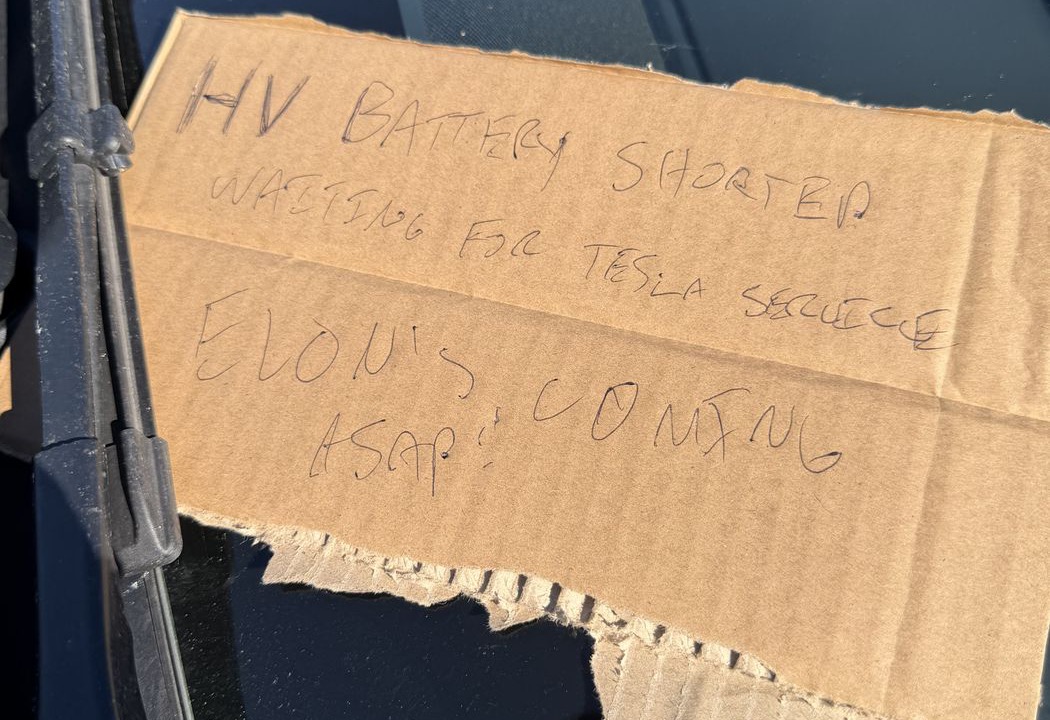
There was nothing to wait for. The car was waiting for a tow. So I found a piece of cardboard and a Sharpie and left a note on the windshield for the other drivers circling the lot: HV BATTERY SHORTED. WAITING FOR TESLA SERVICE. ELON'S COMING ASAP!
I photographed that too. That's the picture at the top of this post.
I made it home with 8 miles of range. Tesla towed the car the next morning and replaced the pack under warranty, no charge. Every photo, every screenshot, and the invoices went into one Google Drive folder. Then I mostly forgot about it.
Two months later
Last week Matt asked if he could use my battery story in a Tesla repair class he's teaching. Real screenshots, real Toolbox data, a real owner experience. That kind of teaching material doesn't exist in any textbook.
Here's everything I did. I opened Claude, asked it to find the draft write-up we'd made of the failure, and described the framing I wanted: this is a story about a car whose subsystems don't talk to each other, told in the order it actually happened, graded against a diagnosis we already had.
My Google Drive is connected to Claude, so it went and did the rest itself. It found the folder. It pulled twelve images out of it. It checked each image against the story: this one is the fault screen, this one is the "Charging Complete" contradiction, this one is the cardboard note. It noticed the photos carried GPS coordinates in their metadata and stripped them before using anything. Then it built the actual presentation, a designed, captioned, exhibit-by-exhibit case study Matt could put in front of a class.
First shareable version: about ten minutes. I never dragged a single file or went hunting through my camera roll.
It wasn't right yet, though. And the way it was wrong is the most useful part of this story.
The machine tells a good story. I was there for the real one.
Claude's first version told the story the way a writer would: mysterious symptoms build, the tension rises, and the diagnosis arrives at the end as the big reveal. It's the natural shape for a story. It's also not what happened.
What actually happened is better, and only I knew it: we had the full diagnosis before the car ever left the driveway. The whole afternoon of contradictory screens came after, with the answer already in hand. That's not a mystery. That's a controlled experiment. For a class full of technicians, that ordering is the entire lesson: get ground truth first, and every symptom becomes evidence you can grade instead of noise you have to chase.
I told Claude the real timeline. It restructured the whole presentation in a couple of minutes. Second correction: the cardboard note wasn't a footnote. It was the only fully accurate status display on the car that day, and it deserved to be the hero image. Two rounds of my corrections, and the thing was done inside the hour.
That division of labor is the whole game. The machine did the assembly: finding, verifying, captioning, laying out. I did the judgment: what actually happened, what it means, what leads. Neither of us could have produced that presentation alone in an hour. Together it was barely work.
What I actually learned
Capture is the skill. The ten-minute presentation was only possible because of what I did on Father's Day, two months before I knew I'd need it. I documented the failure the way a technician documents a repair: in order, screens and context shots and paperwork, all in one folder. Nothing fancy. A phone camera and a Drive folder. Six months of working with AI every day has changed how I capture things. I now photograph and file as if some future assistant is going to need to reconstruct the day without me in the room. Because this time, one did.
Connections turn an archive into material. The folder had been sitting in Google Drive for two months, worth nothing to anyone. The reason it became a finished presentation in ten minutes is that Claude could reach the folder itself. If I'd had to find the photos, download them, and hand them over one at a time, I'd have spent longer on file management than the machine spent on the whole build. Honestly, the project might have stayed on the someday list forever. Connecting your tools to your actual files is the difference between an assistant that gives advice and one that does work.
You supply judgment. It supplies assembly. The first draft was wrong in a way only a person who lived the story could catch. That's not a flaw in the machine; that's the job description. It handled everything that was tedious, and I handled the one thing that required having been there. If you go in expecting to make zero corrections, you'll be disappointed. If you go in knowing your job is the two or three corrections that matter, you'll get an hour of work out of what used to take a week.
The battery was replaced. The habit stayed.
The car's fine, for what it's worth. Remanufactured pack, covered under warranty, drives like nothing happened.
But the thing I'd point at, if you're trying to figure out what any of this AI stuff means for your own day-to-day, is the cardboard note. On a $60,000 car stuffed with software, the clearest piece of communication that day was written with a Sharpie. Clear beats sophisticated every time.
The same rule applies on the other side of this story. Using AI well didn't look sophisticated either. It looked like taking pictures in the right order, keeping them in one folder, connecting that folder to the tool, and knowing the real story well enough to correct a confident first draft. Any smart person can do every one of those things. Most people just don't know yet that they're the things that matter.
If you've got two months of photos sitting in a folder and a vague feeling there's something useful in there, that's exactly the kind of thing I help people with. Reach out.